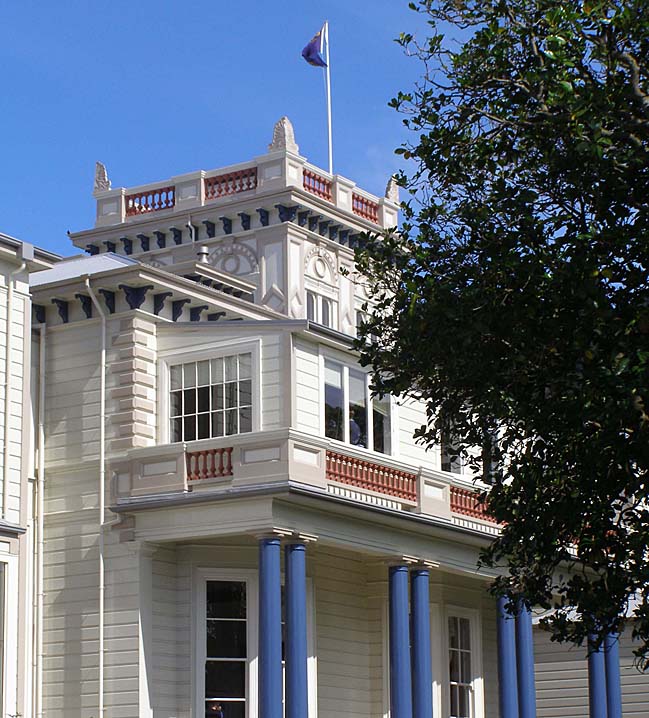
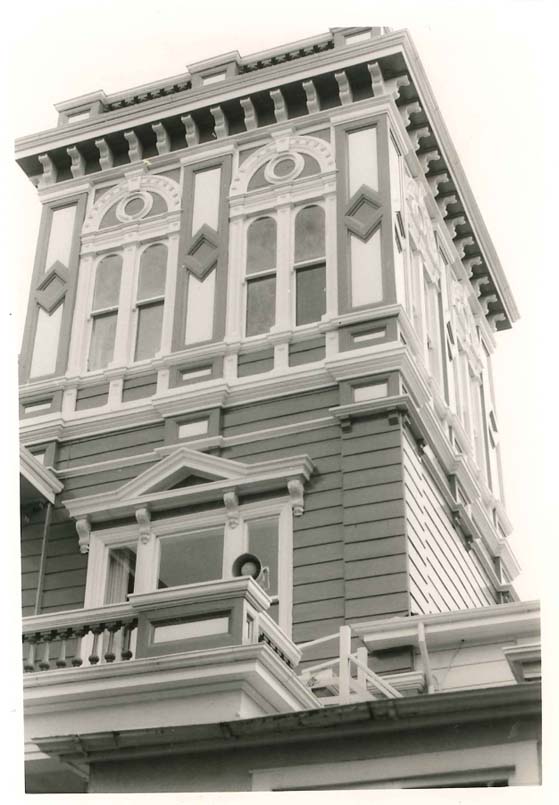
The Tower Building at Queen Margaret College was originally the home of T C Williams, a son of missionary Henry Williams and a wealthy land owner. It was designed by well-known architect Charles Tringham in 1878 as an addition to an existing concrete house. Colonial Architect William Clayton had built a concrete house for himself on the site in about 1873 (one of the first concrete private dwellings and also possibly the first to have hot and cold running water in Wellington). Clayton died on 23 August 1877. In March 1878, the lease and house was sold to Thomas Coldham Williams (1825–1907), fourth son of Bay of Islands missionary, Henry Williams, who had interests in farming stations in the Wairarapa as well as other land in Wellington. Williams hired architect Charles Tringham to design additions to the house, including the tower block, portico, conservatory and balconies.
Architect Charles Tringham also designed Westoe, Kakariki (Register No. 156, Category 1) (1874), Plimmer House in Wellington (Register No. 225, Category 1) (1874), as well as All Saints Church, Foxton and St Mark’s Church, Wellington in 1876, before giving up architecture in the 1890s to become a farmer in the Wairarapa.
T C Williams’s wife was Annie Beetham, daughter of the portrait artist William Beetham, and both the Beetham and Williams families established Brancepeth Station in the Wairarapa. The Williams’s house in Wellington became well known for its social events in the late 19th and early 20th centuries. After Williams died in 1912 his wife went to England. In 1915, the Presbyterian Church took the lease on the land and first opened Scots College. However it outgrew the site within a few years and moved to its present site in Strathmore and Queen Margaret College began in February 1919. The Clayton portion of the house has since been demolished.
The tower is a fine example of Victorian Italianate design. It is three storeys high and reproduces classical motifs in wood that are more usually seen in masonry. The tower is capped by a distinctive Italianate projecting cornice, heavily bracketed, with a balustraded parapet as a further cap. Such towers were designed for their landmark qualities and their evocation of the picturesque. This one is a prominent feature in photographs of 19th century Thorndon.
In the main entrance hall a ‘U’ shaped staircase with a curved landing leads to a gallery at first floor level which is lit by clerestory windows in a raised portion of the roof. The interior is finely finished with carefully chosen timbers, with the kauri panels of the doors being trimmed with Australian blackwood. A spiral staircase gives access to the tower. The tower block was refurbished and strengthened in 2005.
The tower building has historical and social significance from its association with T C Williams and the over 90 years of association with Queen Margaret College. Despite changes to accommodate educational purposes, historic elements such as the tower, main entrance hall and staircase retain high levels of authenticity. The main interior spaces, and the Italianate style tower, have high aesthetic value. The tower also has streetscape appeal.
Architect Charles Tringham also designed Westoe, Kakariki (Register No. 156, Category 1) (1874), Plimmer House in Wellington (Register No. 225, Category 1) (1874), as well as All Saints Church, Foxton and St Mark’s Church, Wellington in 1876, before giving up architecture in the 1890s to become a farmer in the Wairarapa.
T C Williams’s wife was Annie Beetham, daughter of the portrait artist William Beetham, and both the Beetham and Williams families established Brancepeth Station in the Wairarapa. The Williams’s house in Wellington became well known for its social events in the late 19th and early 20th centuries. After Williams died in 1912 his wife went to England. In 1915, the Presbyterian Church took the lease on the land and first opened Scots College. However it outgrew the site within a few years and moved to its present site in Strathmore and Queen Margaret College began in February 1919. The Clayton portion of the house has since been demolished.
The tower is a fine example of Victorian Italianate design. It is three storeys high and reproduces classical motifs in wood that are more usually seen in masonry. The tower is capped by a distinctive Italianate projecting cornice, heavily bracketed, with a balustraded parapet as a further cap. Such towers were designed for their landmark qualities and their evocation of the picturesque. This one is a prominent feature in photographs of 19th century Thorndon.
In the main entrance hall a ‘U’ shaped staircase with a curved landing leads to a gallery at first floor level which is lit by clerestory windows in a raised portion of the roof. The interior is finely finished with carefully chosen timbers, with the kauri panels of the doors being trimmed with Australian blackwood. A spiral staircase gives access to the tower. The tower block was refurbished and strengthened in 2005.
The tower building has historical and social significance from its association with T C Williams and the over 90 years of association with Queen Margaret College. Despite changes to accommodate educational purposes, historic elements such as the tower, main entrance hall and staircase retain high levels of authenticity. The main interior spaces, and the Italianate style tower, have high aesthetic value. The tower also has streetscape appeal.